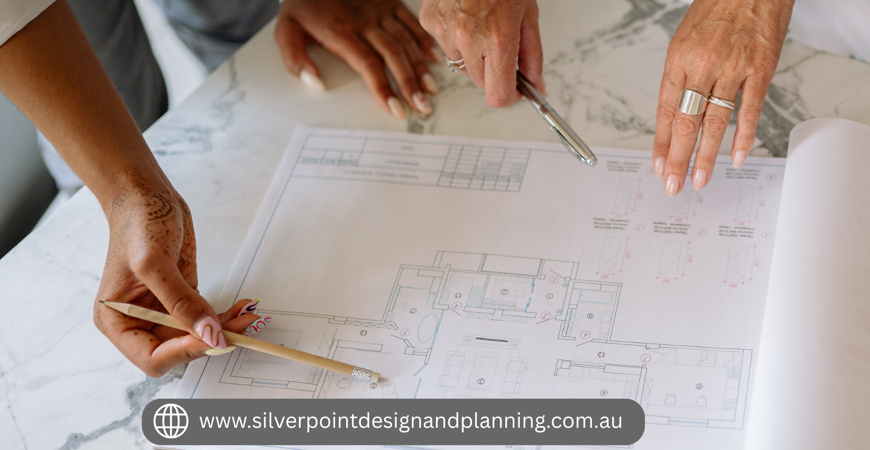
Property owners and developers in Victoria often face challenges and difficulties when attempting to obtain building approval. The information outlined in this blog is an overview of what is involved with the requirements and building approval process for a residential extension, townhouse development, or commercial project. Working with an established and trustworthy building designer in Melbourne has the ability to greatly expedite this process for clients.
The aim of this guide is to provide a summary of the overall stages of acquiring building approvals in Victoria, from initial research to final certification. Although acquiring building approval may seem complicated, understanding the building approval process will make it much easier.
Conducting Thorough Pre-Design Research
Thorough site and regulatory research are the foundation for successful projects. It is necessary to understand the regulations that affect your property prior to developing detailed designs and any constraints that may affect your proposal.
Permitted land use, building height, setback distances, site coverage ratio, and parking requirements are all determined by Victorian planning schemes; these can vary from municipality to municipality and from zone to zone within a single municipality; therefore, a development that may be acceptable in one location may not be acceptable in another location.
Planning overlays add another layer of consideration for your project; for example, heritage, neighbourhood character, environmental significance, and vegetation protection overlays impose additional limits on what can be built and how a development looks.
For townhouse developments, the neighbourhood context is especially important; councils look to see if a new development complements the existing streetscape and respects local architectural character. Reviewing developments that have recently received approval in your local area is an effective way of determining what your council considers appropriate.
Most Victorian councils have now made online planning tools and Geographic Information Systems (GIS) mapping systems available; this makes it easier for you to perform initial research into the above-mentioned considerations. Taking the time to review these constraints at the start of your project will help to ensure that you avoid re-designing your project later in the process at a higher cost.
Understanding Compliance Requirements and Approval Authorities
To ensure a hassle-free building approval process, comply with zoning regulations and the Building Code of Australia. In addition, get input from a local fire safety officer if necessary.
All these authorities have separate duties for issuing permits for your project, and therefore, you will need to provide different types of information to each one at different points in the process. Experienced professionals specialising in town planning in Melbourne can help you do this at an early stage of your project and will provide you with valuable input into the requirements of your council, and also help you identify any possible issues with your proposal before they happen.
What Is the Building Approval Process in Victoria?
The building approval process in Victoria follows a structured pathway to ensure new developments meet planning rules, safety requirements, and construction standards.
Typically, the process starts with checking zoning, overlays, and local planning controls to confirm whether a planning permit is required. Where a planning permit is needed, it must be approved before moving on to the building permit stage.
Once planning approval is in place, or confirmed as unnecessary, detailed construction drawings and supporting documents are prepared to show compliance with the National Construction Code (NCC) and the Building Code of Australia (BCA). These documents are then reviewed by a registered building surveyor as part of the building permit application.
Depending on the scope of the project, other specialists such as engineers, fire safety consultants, or service authorities may also be involved, with documentation required at different stages of the approval process.
Engaging an experienced building designer or town planning consultant early in the project helps coordinate these requirements, identify potential compliance issues, and streamline approvals before costly delays occur.
For more details on how failing to meet specific planning requirements can lead to refusal and how to avoid common pitfalls, seethe guide on Common Reasons Council Rejects Town Planning Applications and How to Avoid Them
What Is Involved in Preparing a Complete Development Application?
Developing a new project begins with your application for a development approval. A development application consists of a series of documents, including architectural plans, site plans, engineering reports, planning assessments, and various supporting documents. The quality of the application submitted will have an impact on how quickly your application proceeds through the council's approval process.
The planning department of the council requires full-drawn documentation to demonstrate how the floor plans, elevations, cross-sections and construction details are designed to meet the Building Code of Australia, Disability Access Standards, Structural Requirements and Fire Safety Requirements. In the last few years, many councils have moved to electronic submission of development applications, which can speed up the review of applications when used correctly.
The time required to conduct a review of a development application will depend on the complexity of the application and the council's resources. Typically, residential extensions may be approved within four to six weeks, while multi-unit developments, commercial developments, and any applications requiring public notification will usually have a review period of several months. During the review of an application, council planning staff will review the application to ensure that it meets the requirements of the applicable planning scheme and may require additional information or further modifications to the application during the review process.
A town planning consultant who has experience understands what the council wants to see in an application and can address potential issues at the beginning of the process. Town planning consultants have existing relationships with the planning department and an understanding of the preferences of the local council, which can result in fewer objections to the application and a more efficient approval of the application.
Understanding Building Code Compliance Requirements
Mandatory technical and safety construction codes in Australia include the National Construction Code (NCC) and Building Code of Australia (BCA). These Codes cover a range of areas, including structural integrity; fire safety; plumbing, drainage, or other piping; electrical systems; accessibility; and energy efficiency. Documentation verifying compliance with all relevant codes is required to be submitted as part of a building permit application.
Engineering calculations verifying structural compliance (e.g., that buildings are able to withstand loads placed upon them in a safe manner) are used to assist with the verification process for structural compliance. To assist with fire and life safety compliance, provisions are made for exits; the type of construction (e.g., Fire Rated); sprinkler systems; lighting systems; etc.
The standards contained in the Codes require all buildings to be designed to accommodate use by all persons, regardless of ability. Examples include entries, door widths, bathrooms, and circulation spaces. Most design deficiencies in these areas would necessitate a redesign by the Architect to be made compliant with the current Codes.
The requirements for energy efficiency are becoming more stringent, with the minimum energy rating for a newly constructed house being six stars. To achieve this rating, designers must carefully plan the materials used for the building envelope, the type and quantity of glazing, and the type and efficiency of the mechanical systems used in the building. In some cases, Councils will provide encouragement for the implementation of environmentally sustainable systems beyond the minimum standards for larger developments.
When designing an extension to or renovating an existing building that was constructed under different Codes, it is essential that the new works conform to the current Code requirements while also being integrated into the existing building that may have been built under older requirements. Working with an experienced professional who specialises in architectural and/or engineering design will provide the most efficient process for addressing these issues.
How Are Design Assessments, Revisions, and Council Requests Managed?
Almost every application will go through at least one round of changes before being approved (the Council may request clarifications, modifications to design, or additional documents). These requests are completely normal in the application Process, and responding quickly with a clearly documented revision will help to keep the timeline moving forward toward an approved application.
If your application is complex, you can meet with council planners prior to submitting your application to clarify the expectations of your submission and reduce any potential delays. It is important to keep comprehensive records of all submitted materials, correspondence, and revision(s) for compliance and future reference.
Why Is Specialist Consultant Coordination Important?
A number of different consultants are involved in the construction of complex facilities; for example, structural, civil and building services engineers. In larger developments, additional consultants may be required, such as landscape, traffic or acoustic specialists.
Ensuring that each consultant produces documentation that is consistent with the other consultants’ documentation avoids disputes, which can lead to construction delays. Coordination of design integration through early review processes will enable issues to be identified and resolved prior to submission of an application and create a more efficient and expedited approval process.
What Are the Approval Requirements for Subdivision Projects?
For a project to have potential to subdivide, there are many needed approvals, including: size of lots; right of way; services; and neighbourhood character. These projects also usually gain a DRP permit for the building prior to getting their subdivision approval at the same time.
By planning for subdivision at an early stage with the help of a building designer near you, in conjunction with surveyors and engineers, the building design and land subdivision are coordinated to create a more efficient approval process.
What Happens After Approval During Construction and Final Certification?
Once the permit has been granted and the construction process has begun, the building surveyor will carry out required inspections at key construction phases, such as, but not limited to, footings, framing, waterproofing, and final completion of the project. The building surveyor must conduct each inspection prior to allowing the next phase of construction to continue.
Once all inspections are complete, the final inspection will be done, and an occupancy certificate will be issued. This occupancy certificate is required for the building to be occupied legally.
Why Choose SilverPoint – Building Designers & Planning Consultants
One must have expertise, clarity, and a solid understanding of any local government building codes in order to successfully navigate and advice for the Victoria Building Permit process. SilverPoint - Building Designers & Planning Consultants offers Melbourne-wide and state-wide integrated professional building design and planning services.
With over four decades of experience in designing residential extensions, building multiple townhouses, and commercial projects, we work with councils to expedite and manage the approval process, to ensure compliance with all relevant legislation and to minimise delays. The objective of these services is to offer practical, compliant design solutions that help protect your investment while providing for an efficient progression of your projects from concept to final approvals.
Conclusion
In Victoria, the process of gaining a building permit is a complex combination of building approval processes, agencies and legal requirements that can be difficult to navigate without expertise and guidance. The process of turning your idea into a successful building involves many stages: conducting initial research and designing plans, obtaining various building permits and approvals, and completing inspections and final certification. Each stage of this process is critical to achieving successful construction projects that are safe and compliant with relevant building codes and standards.
With an experienced building designer and planning consultant in Melbourne or across Victoria by your side as your project develops, you will find that you will have significantly reduced risk and have avoided unnecessary delays and additional costs associated with redesign. When an expert is involved with your project, building approvals will become a defined, structured and manageable pathway rather than a barrier.
With support, advice, and guidance from SilverPoint - Building Designers & Planning Consultants, you will be able to proceed with confidence and clarity.


